
This post is written as political-theological commentary and reflects the author’s personal reflections and interpretations. It is not an academic article, nor does it claim to represent any official position. The views expressed here are subjective and exploratory, rooted in lived experience, geopolitical observation, and philosophical inquiry.
In the shadow of geopolitical escalation between Israel and Iran, a deeper existential crisis is unfolding. It is not merely about borders, ideology, or hegemony. It concerns the place of human beings in an increasingly algorithmic world.
Artificial intelligence systems are beginning to outperform humans in strategy, prediction, and language generation. As a result, many actors in the region turn in unexpected directions.
Paradoxically, they do not turn toward reason. Instead, they turn toward messianic and apocalyptic narratives.
This retreat into theological frameworks is not a coincidence, but rather a compensatory response to the erosion of human supremacy.
Messianism, whether in the form of the Jewish Mashiach or the Shiite Imam Zaman, functions as a theological mechanism for restoring meaning in a world where human agency is no longer guaranteed. In both Israeli and Iranian societies, religious prophecy serves not only as a political tool but as a psychological balm. As machine learning models make decisions faster and often more effectively than human beings, the belief in an imminent divine redeemer allows people to reclaim a sense of ontological importance. In this way, messianism becomes not a sign of faith, but of profound anxiety.
The irony is acute: while both Israel and Iran invest heavily in AI technology—whether for surveillance, cyberwarfare, or military automation—the public rhetoric on both sides often invokes ancient prophecies, martyrdom, and redemption. In effect, the most technologically advanced weapons are being deployed under the banner of the most pre-modern mythologies. The machine may be post-human, but the ideology surrounding it is deeply pre-modern.
This dynamic echoes a broader philosophical crisis. Like the Copernican and Darwinian revolutions, AI threatens to dethrone humanity from its privileged epistemic and moral position. It is a humbling moment: if machines can analyze better, diagnose faster, and even compose music or poetry with coherence, what then is left that is uniquely human? In response to this humiliation, societies may double down on irrational belief systems, not because they are primitive, but because they are symbolic assertions of value in a world that no longer needs us at the center.
Thus, we may say: “When algorithms outperform prophets, nations turn to prophecy to reassert their place in the world.” The current Israel-Iran conflict, in its symbolic dimension, is not just about territory or nuclear capability. It is also about who owns the future in an age when the future may be increasingly authored by non-human intelligence.
In this light, studying the fusion of theology and technology is not an eccentric academic exercise, but a crucial lens for understanding 21st-century geopolitics. The messiah, the hidden imam, and the machine are all vying for narrative control. And in that contest, the most powerful weapon may not be missiles or code — but meaning itself.
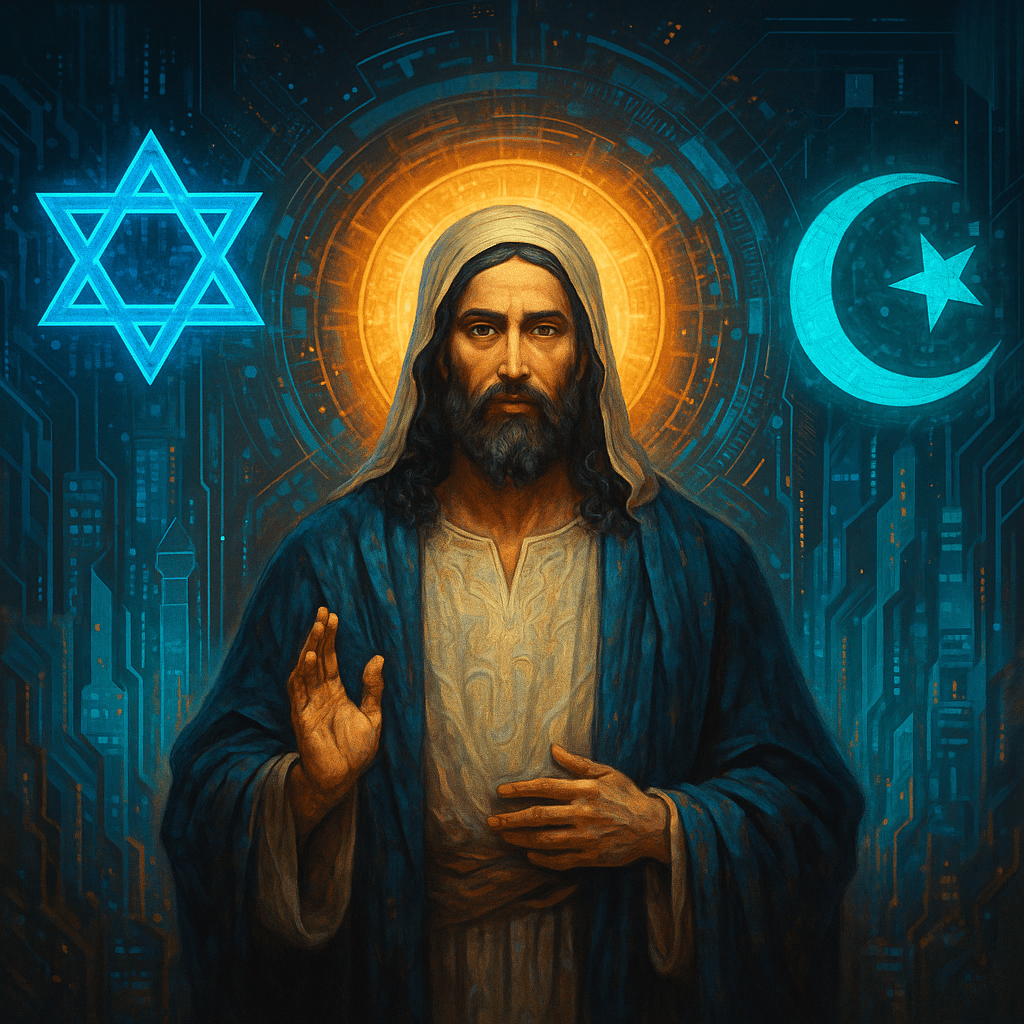
his pattern is not unique to the Middle East. In the United States, the election of Donald Trump can be read as a parallel case of apocalyptic populism. For many, Trump represented not merely a political figure but a messianic disruptor — a symbol of restoration in a world perceived to be unraveling under the forces of globalization, secularism, and algorithmic governance. His rise was driven not by policy or reasoned debate but by a charismatic appeal rooted in prophecy, nostalgia, and a rejection of technocratic elites. In this light, Trumpism mirrors the same compensatory logic: when faced with the erosion of human supremacy in an automated world, societies turn to irrational yet symbolically potent figures who promise redemption and control.
Apocalyptic populism refers to a mode of political discourse that combines populist rhetoric (the pure people vs. the corrupt elite) with a narrative of impending doom or salvation. It frames political struggle as an existential battle between good and evil, often invoking religious, mythological, or civilizational imagery to justify radical action or the suspension of democratic norms.
This term fits especially well when describing:
- Trumpism (as a Manichaean worldview where Trump is “chosen” to save the nation from evil)
- Christian nationalist movements that cast politics in eschatological terms
- Iranian state ideology when it leans on the return of the Imam Zaman
- Zionist messianism in parts of the Israeli right
 Leafy sees
Leave a Reply