
**
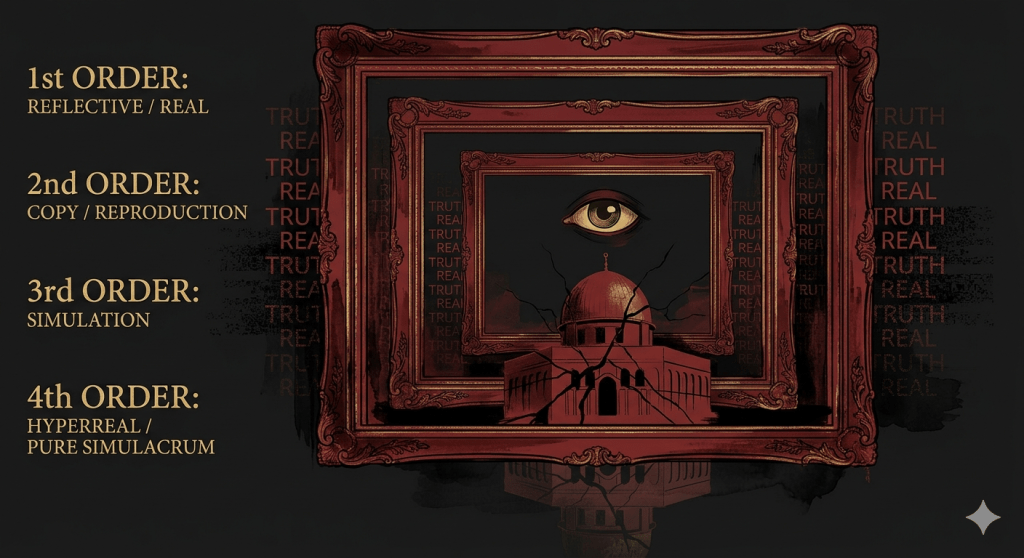
In Jean Baudrillard’s philosophy, a *simulacrum* (plural: *simulacra*) refers to a representation, image, or sign that not only copies reality but eventually supplants or precedes it, leading to a state of hyperreality — in which the distinction between the real and the simulated dissolves.
Baudrillard describes this as a progression through four orders: beginning with faithful reflections of reality, moving through distortions and masks for absent realities, and culminating in pure self-referential simulations that bear no relation to any original referent. In hyperreality, “objective truth” gives way to these copies, producing what Baudrillard calls the *death of the real* — where simulations dominate perception and experience.
Applied to Iran, the concept of simulacrum reveals how the Islamic Republic’s authoritarian system constructs hyperreal narratives — through propaganda, media control, and political discourse — that obscure actual events, sustain power, and manipulate both domestic and international perceptions. This ties directly into what I have elsewhere framed as semantic terrorism: the weaponization of language and images to invert meanings and erode shared reality. As one analysis notes, in Iran’s hyperreality, politics is “no longer about truth; it is about the simulation of truth.”
**Key Applications and Examples**
Iranian propaganda frequently operates at the third and fourth orders of simulacra — masking absences or generating self-sustaining illusions detached from reality — fostering epistemic confusion in which citizens and observers struggle to discern truth amid simulated spectacles.
*Media Representations of Protests and Repression (Third-Order Simulacra)*
State media such as IRIB broadcasts coerced confessions and edits protest footage to simulate “foreign conspiracies” or “terrorism,” masking the absence of any such plots. During the 2025–2026 uprisings, information blackouts created “silence vacuums” filled with hyperreal narratives: protesters reframed as “enemies,” deaths inverted as “defensive actions.” Echoing Baudrillard’s Gulf War critique, repression became a simulated “war” that did not take place in its claimed form, while real grievances — economic despair, executions — were erased from view.
*Anti-Imperialist Discourse in Foreign Policy (Fourth-Order Simulacra)*
The regime appropriates “anti-imperialist” rhetoric to defend internal colonialism and theocracy, creating pure simulacra in which signs such as “human rights” refer only to regime self-interest. Spokespeople label criticism as “Orientalist hegemony,” simulating a Global South revolutionary stance even as the regime suppresses Kurds and Baluch. This hyperreality exploits Western guilt and paralyzes solidarity — a “war of metaphors” in which representations dominate, detached from factual oppression.
*Cultural and Artistic Simulations*
In Iranian art — such as Azadeh Akhlaghi’s photographic reconstructions of historical deaths — simulacra both challenge and mirror state narratives, producing “copies without originals.” Conversely, state-sponsored media such as *Zahra’s Blue Eyes* fabricates simulacra of enmity to unify domestically through a self-referential loop far removed from actual geopolitics.
*Elections and Political Spectacles*
Iranian elections function as simulacra of democracy: candidates are pre-vetted, turnout is manipulated, outcomes predetermined. Media simulates “participation” and constructs a hyperreal “will of the people” that sustains theocracy while actual dissent is criminalized.
**Implications**
In this hyperreal Iran, simulacra enable control through information overload and epistemic paralysis. Citizens live within mediated spectacles, doubting their own experiences. Truth dies — politics becomes not the pursuit of truth but the simulation of it. Countering this requires epistemic resistance: exposing the simulations and reclaiming grounded narratives, as organizations like HRANA attempt through documentation.
—
**References**
Baudrillard, J. (1995). *The Gulf War did not take place* (P. Patton, Trans.). Indiana University Press.
Baudrillard, J. (2002). *The spirit of terrorism and requiem for the twin towers*. Verso.
Der Derian, J. (1990). The (S)pace of international relations. *International Studies Quarterly, 34*(3), 295–310. https://doi.org/10.2307/2600571
Hassaniyan, A. (2024). The Islamic Republic of Iran’s multipronged approach to the repression of Kurds. *Contemporary Review of the Middle East, 11*(3), 292–315. https://doi.org/10.1177/23477989241258897
Khan, S. (2024). The medium is the message. *Daath Voyage Journal, 9*(3), 56–64.
Martinez, S., & Chen, D. (2024). Hyperreality and international politics. *Contemporary Political Theory*.
Shariati, M. J. (2025, August 15). Iran and the problem of hyperreality. IPIS. https://www.ipis.ir/en/newsview/774554/iran-and-the-problem-of-hyperreality
 Leafy sees
Leave a Reply