
In the age of “semantic terrorism,” information is weaponized to obscure reality. The Human Rights Activists News Agency (HRANA) has emerged as a vital pillar of epistemic clarity.
As a veteran activist, I’ve seen how quickly narratives are hijacked. State propaganda seizes control on one side. Radicalized echo chambers dominate on the other. In this landscape, HRANA doesn’t just provide news—it provides a verified bedrock for justice.
The “Verification First” Philosophy
Social media is currently flooded with unverified claims. “Viral” counts reach tens of thousands. However, HRANA remains notoriously rigorous. Their methodology is built on triangulation. By the middle of this January 2026 crisis, they have confirmed 3,090 deaths. This number is lower than the more sensationalist reports. However, it is backed by names, locations, and corroborated evidence. In a time of state-sponsored “big lies,” this commitment to documented truth is a revolutionary act.
Bridging the Digital Divide
HRANA’s importance is underscored by its “internal-out” structure. It operates as the news arm of Human Rights Activists in Iran (HRA). It uses a vast network of volunteers. These volunteers risk their lives to smuggle data through the “National Information Network” (NIN) blackouts. Their work transforms ephemeral social media clips into “legal-grade” documentation used by the UN and international courts.
Beyond the Headlines: Documenting Marginalization
Importantly, HRANA moves beyond the “event-based” reporting of the mainstream media. They focus on the systemic:
* Labor Rights: Tracking the suppression of trade unions.
* Minority Rights: Highlighting the persecution of Baha’is and ethnic minorities.
* Prison Conditions: Reporting 24/7 on the treatment of “prisoners of conscience.”
For those of us tracking the sociology of resistance, HRANA is the ultimate filter. They remind us that the most powerful weapon against state repression is not just a louder voice. More importantly, it is a more accurate one.
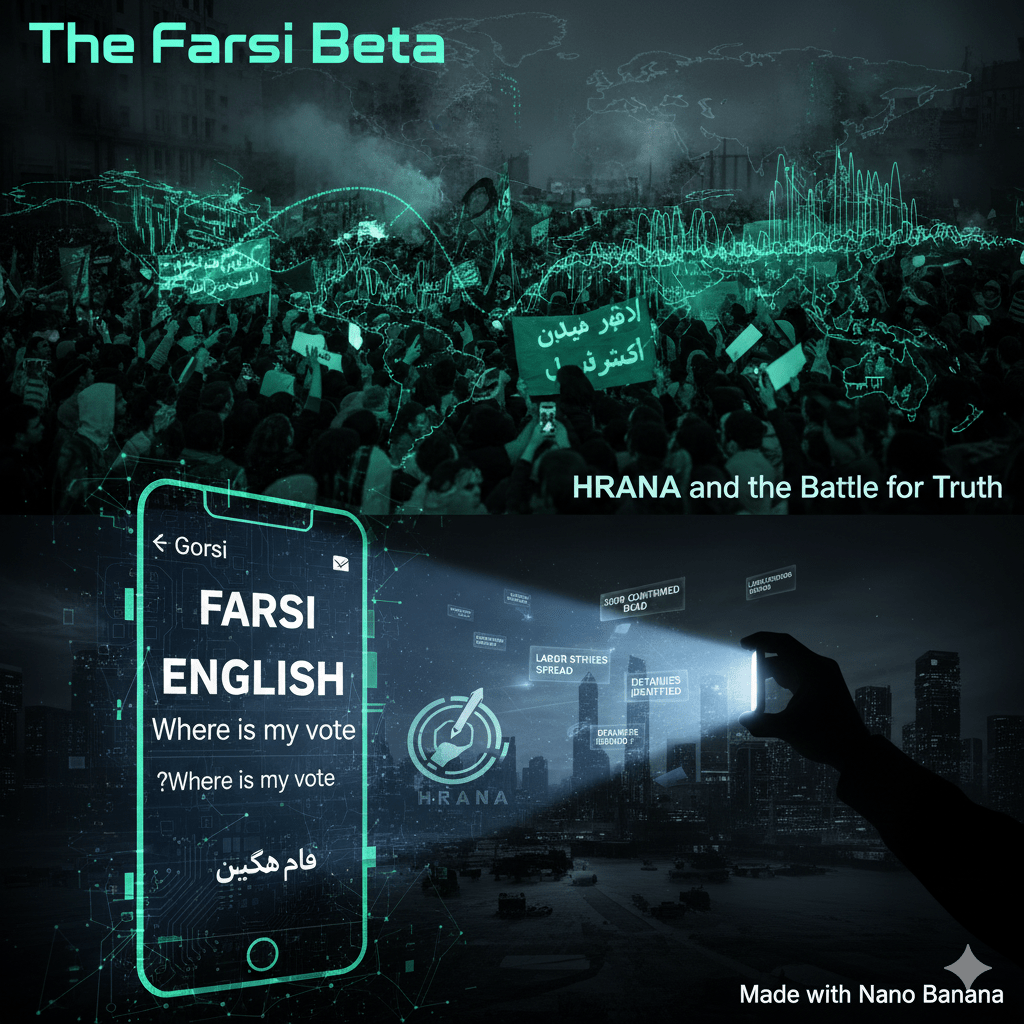
HRANA verifies casualty figures during Iran’s internet blackouts using an extensive internal network of primary sources. These include on-the-ground activists who relay data via alternative channels despite NIN restrictions. This enables triangulation of evidence such as eyewitness accounts, hospital reports, and smuggled footage. It confirms 3,090 deaths, including 2,885 protesters, as of January 17, 2026. This is achieved even with connectivity at 2% of normal levels.[aljazeera][youtube]
Network of Sources
HRANA draws from hundreds of volunteers inside Iran. They collect names, photos, ages, and locations of victims. This information is cross-verified across multiple independent reports. These insiders bypass blackouts through satellite tools like Starlink (despite jamming) or physical smuggling of data.[youtube][bbc]
Triangulation Process
Verification requires at least three corroborating sources per casualty. These include family confirmations, morgue records, and video evidence. This process slows but ensures accuracy amid disruptions. NetBlocks notes blackouts hinder real-time flow, but HRANA’s pre-existing network sustains updates.[cnbc]
Challenges and Reliability
Blackouts since January 8 have limited mobile and internet access. Despite this, HRANA documents 18,470 arrests across 617 protests in 187 cities. These records are used by UN courts. Their figures remain conservative compared to state claims or higher estimates, prioritizing documented truth.[en-hrana]
HRANA Bibliography (APA Style)
Al Jazeera. (2026, January 15). What is HRANA, the US-based group behind Iran’s death toll figures. https://www.aljazeera.com/news/2026/1/15/what-is-hrana-the-us-based-group-behind-irans-death-toll-figures[aljazeera]
BBC News. (2026, January 14). More than 2000 people reported killed at Iran protests. https://www.bbc.com/news/articles/cr57vmznmd9o[bbc]
CNBC. (2026, January 17). Death toll in Iran protests over 3000, rights group says. https://www.cnbc.com/2026/01/17/iran-death-toll-protests-over-3000-dead-.html[cnbc]
Daily Sabah. (2026, January 16). Deaths in Iran protests soar past 3000, rights group says. https://www.dailysabah.com/world/mid-east/deaths-in-iran-protests-soar-past-3000-rights-group-says[dailysabah]
HRANA. (2026, January 11). Day fifteen of Iran’s nationwide protests: Sharp rise in human casualties. https://www.en-hrana.org/day-fifteen-of-irans-nationwide-protests-sharp-rise-in-human-casualties/[en-hrana]
Reuters. (2026, January 11). Deaths from Iran protests reach more than 500. https://www.reuters.com/business/media-telecom/confronting-protests-iran-vows-strike-back-if-us-attacks-2026-01-11/[reuters]
TRT World. (2026, January 16). Iran protests death toll tops 3000 as internet slowly flickers. https://www.trtworld.com/article/f0dc2a948c21[trtworld]
Wikipedia. (2026). 2026 Iran massacres. https://en.wikipedia.org/wiki/2026_Iran_massacres[en.wikipedia]
 Leafy sees
Leave a Reply