
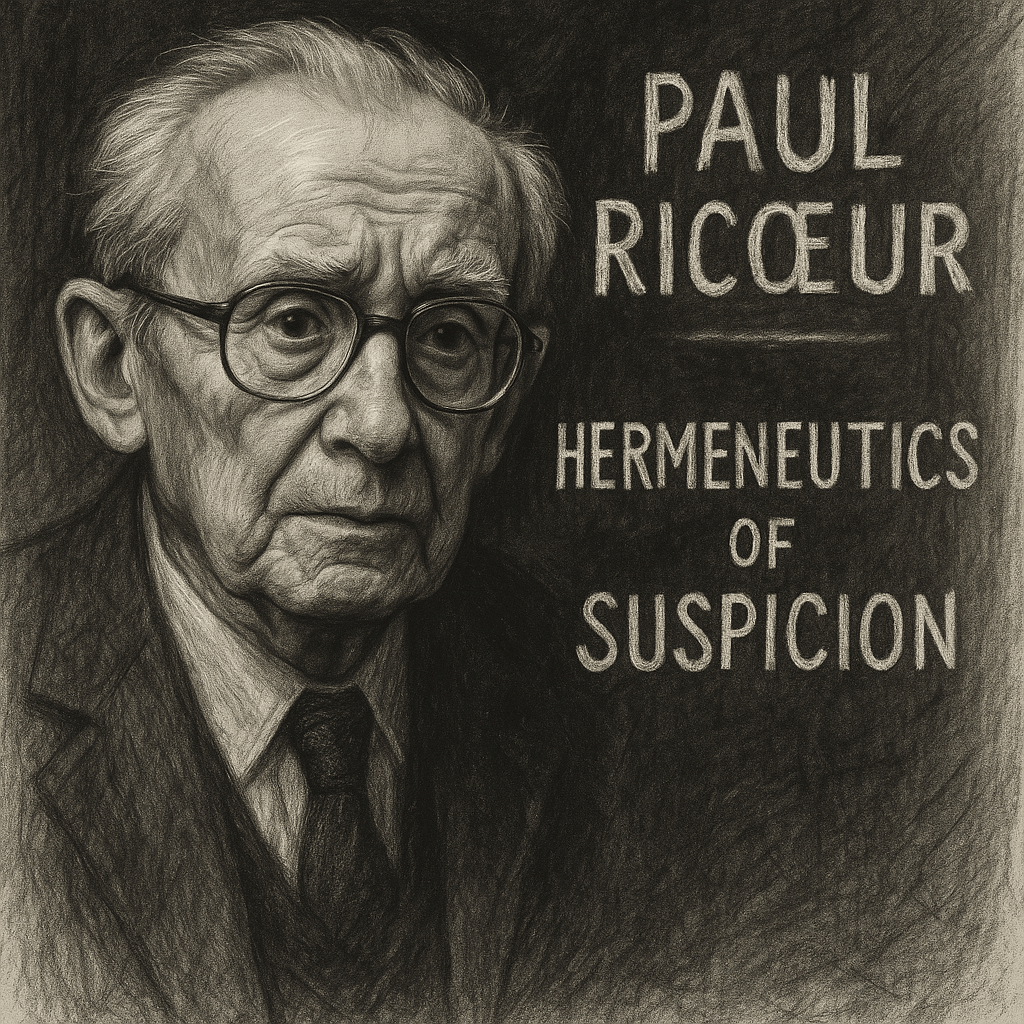
Summary: Paul Ricœur’s Hermeneutics of Suspicion
- Marx exposed how ideology masks economic domination and class interests.
- Nietzsche unmasked moral values as disguises for the will to power.
- Freud revealed unconscious desires and repressions beneath conscious thought.
From these thinkers, Ricœur defined suspicion as a demystifying hermeneutic, aimed at uncovering hidden meanings and challenging accepted truths.
Ricœur contrasts this with the hermeneutics of faith. This approach aims to restore or recover meaning. It does so by listening openly to a text or message. He argues that interpretation requires both modes. Suspicion protects us from naïve acceptance of surface meanings. Faith prevents interpretation from collapsing into endless doubt or cynicism.
Ultimately, Ricœur’s hermeneutics of suspicion highlights the need for a balanced, dialectical approach to understanding meaning—one that recognizes how language, institutions, and consciousness are shaped by forces that are not immediately visible, while still preserving the possibility of reconstructing meaning after critique
Paul Ricœur’s hermeneutics of suspicion is a critical mode of interpretation. It assumes surface meanings—whether in texts, institutions, or human consciousness—cannot be taken at face value. Instead, they must be decoded, unmasked, or read “against the grain.” This approach helps reveal deeper structures of power, ideology, or unconscious motivation.
Ricœur associated this approach with what he called the “masters of suspicion”: Marx, Nietzsche, and Freud. Each, in his own way, argued that human beings are often deceived about the true sources of their beliefs and actions:
Hermeneutic Terrorism: The Weaponization of Meaning and the Rationalization of Paranoia in Digital Discourse
By Leafy_sees
Abstract
In classical critical theory, hermeneutics—the theory of interpretation—serves as a bridge between text and understanding. The contemporary digital landscape has given rise to a phenomenon I term Hermeneutic Terrorism.
It is a systemic strategy by powerful actors (political, algorithmic, and ideological) to foreclose the possibility of independent interpretation. By collapsing the cognitive space between an event and its assigned meaning, this mechanism enforces a “hermeneutics of paranoia.”
This essay argues that in such an environment, paranoia stops being a pathology. Instead, it functions as a rational epistemological defense against coerced meaning.
The Collapse of Interpretive Distance
Michel Foucault argued that power is not merely repressive.
It is also productive. It produces reality, domains of objects, and rituals of truth. In the digital era, power operates by producing instantaneous truth. Foucault’s concept of power/knowledge suggests that those who control the discourse control the subject.
Hermeneutic Terrorism
It acts as a disciplinary mechanism that accelerates this control. It eliminates the temporal gap required for critical reflection—what might be called “interpretive distance.”
By pre-loading symbols with binary moral frames and stripping away nuance, the actor commits an act of epistemic violence.
The subject is not invited to read the text; they are commanded to react to it.
“Power is acceptable only on condition that it masks a substantial part of itself. Its success is proportional to an ability to hide its own mechanisms.” — Michel Foucault, The History of Sexuality [1].
In this context, the “terrorism” lies in the visibility of the threat: Interpret this differently, and you will be exiled.
From Suspicion to Paranoia
Paul Ricoeur famously coined the “hermeneutics of suspicion” to describe the interpretive methods of Marx, Nietzsche, and Freud. For Ricoeur, suspicion was a tool to unmask false consciousness and reveal hidden truths. It was an active, intellectual pursuit—a way to strip away illusions to find the real meaning underneath.
“Hermeneutics seems to be driven by two motivations. There is a willingness to suspect and a willingness to listen. It also embodies a vow of rigor and a vow of obedience.” — Paul Ricoeur, Freud and Philosophy [2].
However, under the pressure of Hermeneutic Terrorism, this active suspicion degrades into reactive paranoia. The digital subject does not suspect in order to find truth; they suspect in order to survive. Every narrative is framed as hostile. Every symbol is a potential trap. As a result, the “willingness to listen” that Ricoeur speaks of becomes impossible. The subject retreats into a fortress of paranoia. They read every sign not for its content, but for its intent to harm.
The Affective Economy of Terror
Why is this form of terrorism so effective? Sara Ahmed’s work on the cultural politics of emotion provides the answer. Ahmed describes how emotions “stick” to objects and signs, accumulating value through circulation.
Hermeneutic terrorism uses “sticky” signs. These are images and words already saturated with fear, disgust, or outrage before they even reach the viewer.
“Emotions are not simply ‘within’ or ‘without.’ They create the very effect of the surfaces or boundaries of bodies and worlds.” — Sara Ahmed, The Cultural Politics of Emotion [3].
By circulating highly charged, pre-interpreted symbols, actors bypass the cognitive filter and appeal directly to the affective body. The “hermeneutics of paranoia” is an emotional response to a world. In this world, signs are weaponized to stick to us, define us, and often, to shame us.
Conclusion: The Crisis of Shared Reality
The ultimate casualty of Hermeneutic Terrorism is the shared reality necessary for political life. When paranoia becomes the only rational mode of reading the world, dialogue collapses. We are left with a fragmented public sphere where trust is a liability and interpretation is a battlefield. Resisting this requires more than just fact-checking. It requires reclaiming the right to interpret. We need to pause, to hesitate, and to refuse the immediate emotional binaries forced upon us.
References
- Foucault, M. (1978).The History of Sexuality: An Introduction. Pantheon Books.
- Context: Foucault explores how power is linked to the production of truth and discourse.
- Link to text/summary (Stanford Encyclopedia of Philosophy)
- Ricoeur, P. (1970).Freud and Philosophy: An Essay on Interpretation. Yale University Press.
- Context: The origin of the “hermeneutics of suspicion,” distinguishing between hermeneutics as a restoration of meaning vs. hermeneutics as demystification.
- Link to book overview (Yale University Press)
- Ahmed, S. (2004).The Cultural Politics of Emotion. Edinburgh University Press.
- Context: Ahmed discusses “affective economies” and how emotions align individuals with communities while excluding others.
- Link to book overview (Duke University Press)
- Sedgwick, E. K. (2003).Touching Feeling: Affect, Pedagogy, Performativity. Duke University Press.
- Additional Reading: Sedgwick offers a famous critique of “paranoid reading.” She favors “reparative reading,” which could serve as a solution or counter-point to your concept.
- Link to text (Duke University Press)

 Leafy sees
Leave a Reply