
With CPTSD, I know I am prone to distrust, to feel betrayal even before it’s proven.
That is my bias. I also know we all share another bias. When faced with horrific stories of abuse, the human instinct is to deny. Still, what troubles me most now is how global conspiracy cultures migrate into our own wounds.
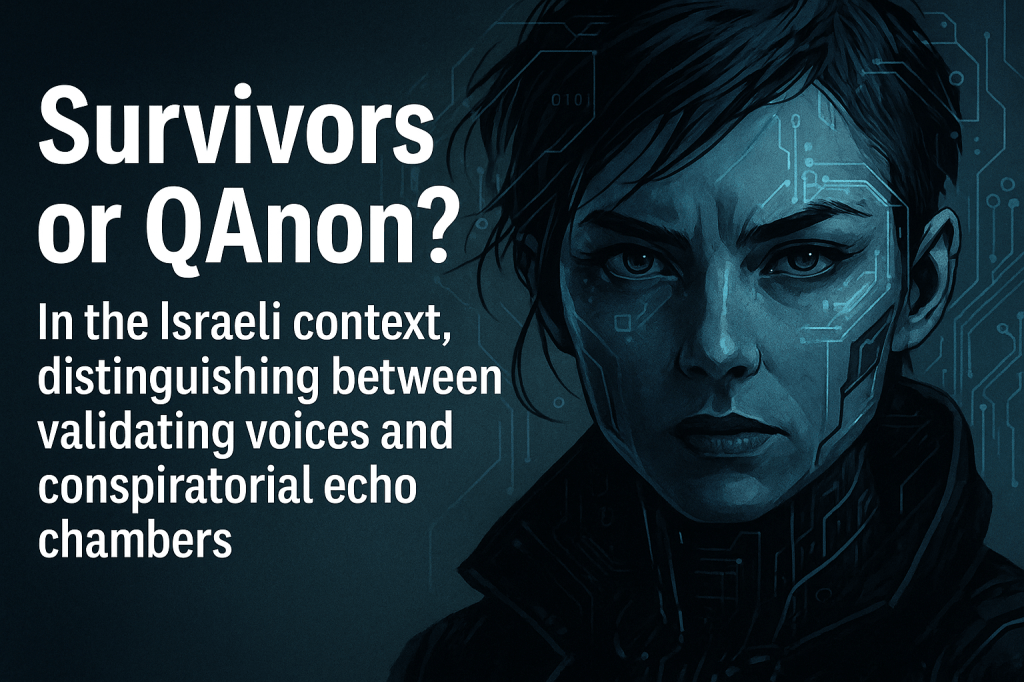
The Israeli version of QAnon, an unsettling isomorphism, is taking root in survivor discourse.
It sometimes attacks survivors instead of amplifying them.
It can be jealous and suspicious. It demands leaps of faith that are beyond my ability. This is not solidarity. This is another silencing.
Trusting Survivors, Honoring Journalism — Without Falling Into Conspiracy
I stand responsibly behind the work of investigative journalist Noam Barkan. In April, their exposé in Israel Hayom titled “Bottom of Darkness” revealed deeply disturbing testimonies.
It detailed accounts of ritualistic child abuse in Israel. These stories are so harrowing they defy imagination (Israel Hayom, Threads summary).
These revelations sparked a watershed moment.
Survivors like Yael Ariel and Yael Shitrit came forward to testify before the Knesset, describing organized abuse that included ritualistic ceremonies, trafficking, and violence by trusted figures
(Jerusalem Post, America’s Future).
This public reckoning was both overdue and profoundly impactful.
But There’s a Troubling Turn: Conspiratorial Echo Chambers
These testimonies are deeply validating. Still, I’m also witnessing something dangerously familiar in certain online communities: a drift toward conspiracy-style discourse, typified by QAnon.
In these spaces, claims often take on a life of their own — untethered from verification, disconnected from mainstream reality. For example:
- Beyond survivor testimonies, some corners online have adopted speculative layers involving satanic conspiracies, occult symbolism, or sprawling cover-ups.
- Platforms such as medicalkidnap.com and sgtreport.com illustrate how horror gets amplified for spectacle, echoing the dynamics of past moral panics.
The abuse allegations deserve every bit of the spotlight. But the conspiratorial framing risks drowning them in sensationalism. It undermines survivors’ credibility, muddies public understanding, and feeds cynicism rather than clarity.
Between Systemic Betrayal and Conspiratorial Hijacking
I am not naïve. I have experienced how the system betrays survivors: police silencing, prosecutors lying, media defaming.
I lost my best friend to a horrific group assault where none of the offenders was charged,
and I fought for years to bring her justice after her death.
I know the system is not “working in our favor.”
But I also know that conspiratorial hijacking is no solution. When survivor voices are pulled into QAnon-style frameworks, they are used rather than heard.
Survivors deserve clarity, compassion, and justice. They should not be caught between failed institutions. Movements exploit their pain for narrative power.
Conclusion
I may have potential biases. My approach is rooted in discourse analysis rather than in concrete evidence.
Therefore, I suggest reading this piece with discretion. I could be wrong. This is also why I am not naming names. This is why I am not sharing this on Israeli mainstream social media. Additionally, this is why I am not even writing in the language of origin.
I am sharing this for those who want to look deeper. Like me, they may feel the same discomfort I do.
If you cannot believe every survivor account, that is not your fault. If some calls for emotional or financial support feel beyond your capacity to answer, that too is okay. It is okay not to make that investment, to prioritize your own well-being, and to recognize your limits.
I say this to myself as much as to you, my reader
 Leafy sees
Leave a Reply